

New Trump tariffs: early modelling shows most economies lose – the US more than many

Midcoast Financial Planning • September 16, 2025

The global rollercoaster ride of United States trade tariffs has now entered its latest phase.

President Donald Trump’s April 2 “Liberation Day” announcement placed reciprocal tariffs on all countries. A week later, amid financial market turmoil, these tariffs were paused and replaced by a 10% baseline tariff on most goods.

On July 31, however, the Trump Administration reinstated and expanded the reciprocal tariff policy. Most of these updated tariffs are scheduled to take effect on August 7.


To evaluate the impact of these latest tariffs, we also need to take into account recently negotiated free trade agreements (such as the US-European Union deal), the 50% tariffs imposed on steel and aluminium imports, and tariff exemptions for imports of smartphones, computers and other electronics.

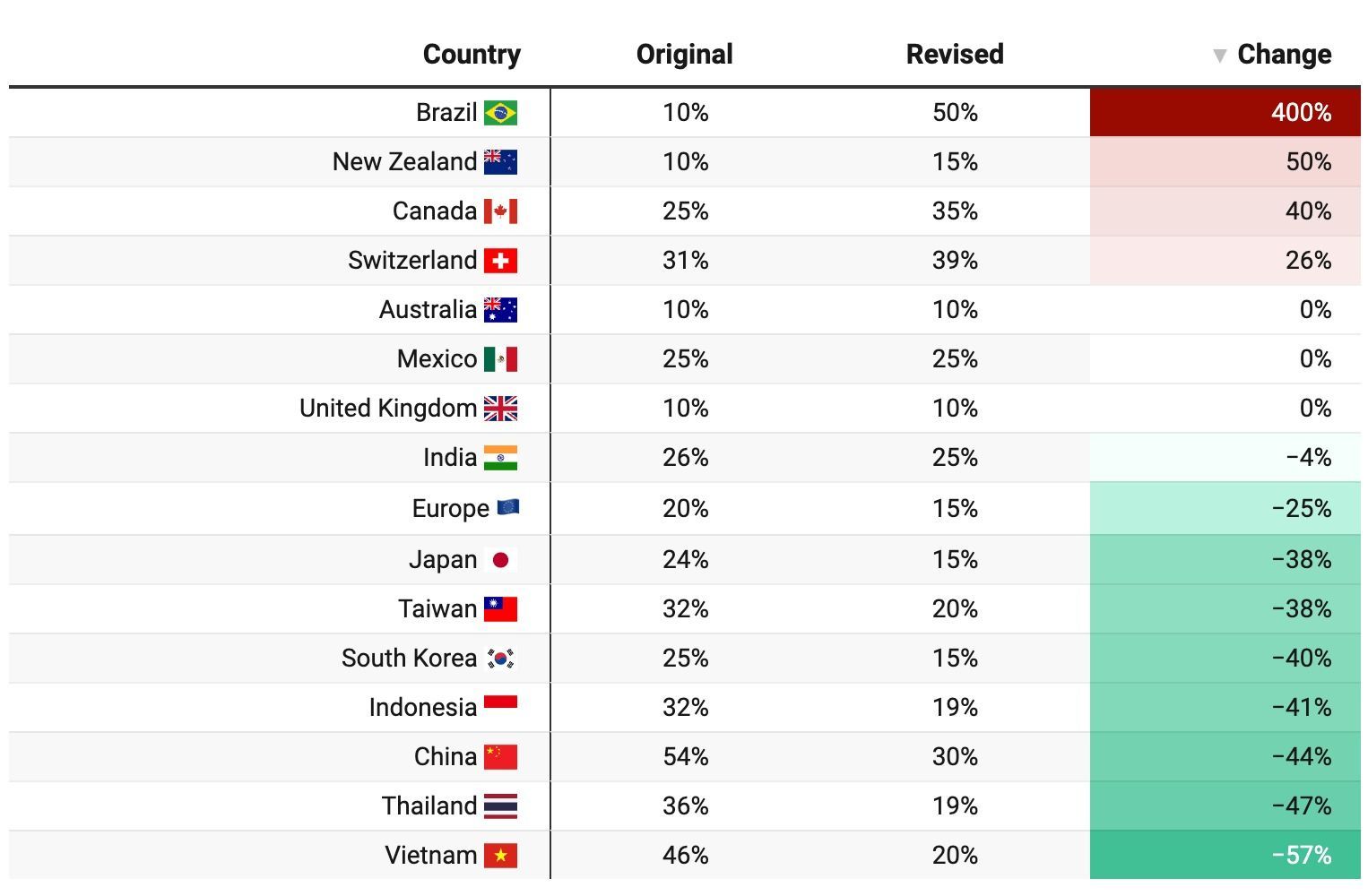
For selected countries, the reciprocal tariffs announced on April 2 and the revised values of these tariffs are shown in the table below. The revised additional tariffs are highest for Brazil (50%) and Switzerland (39%), and lowest for Australia and the United Kingdom (10%).


Original and revised reciprocal tariffs (%)

Table Comparing

Source: Niven Winchester

For most countries, the revised tariffs are lower than the original ones. But Brazil, Switzerland and New Zealand are subject to higher tariffs than those announced in April.


In addition to the tariffs displayed above, Canadian and Mexican goods not registered as compliant with the US-Mexico-Canada Agreement are subject to tariffs of 35% and 25% respectively.


Economic impacts

The economic impacts of the revised tariffs are examined using a global model of goods and services markets, covering production, trade and consumption.

A similar model was used to assess the impacts of the original reciprocal tariffs and the outcome of a US-China trade war.


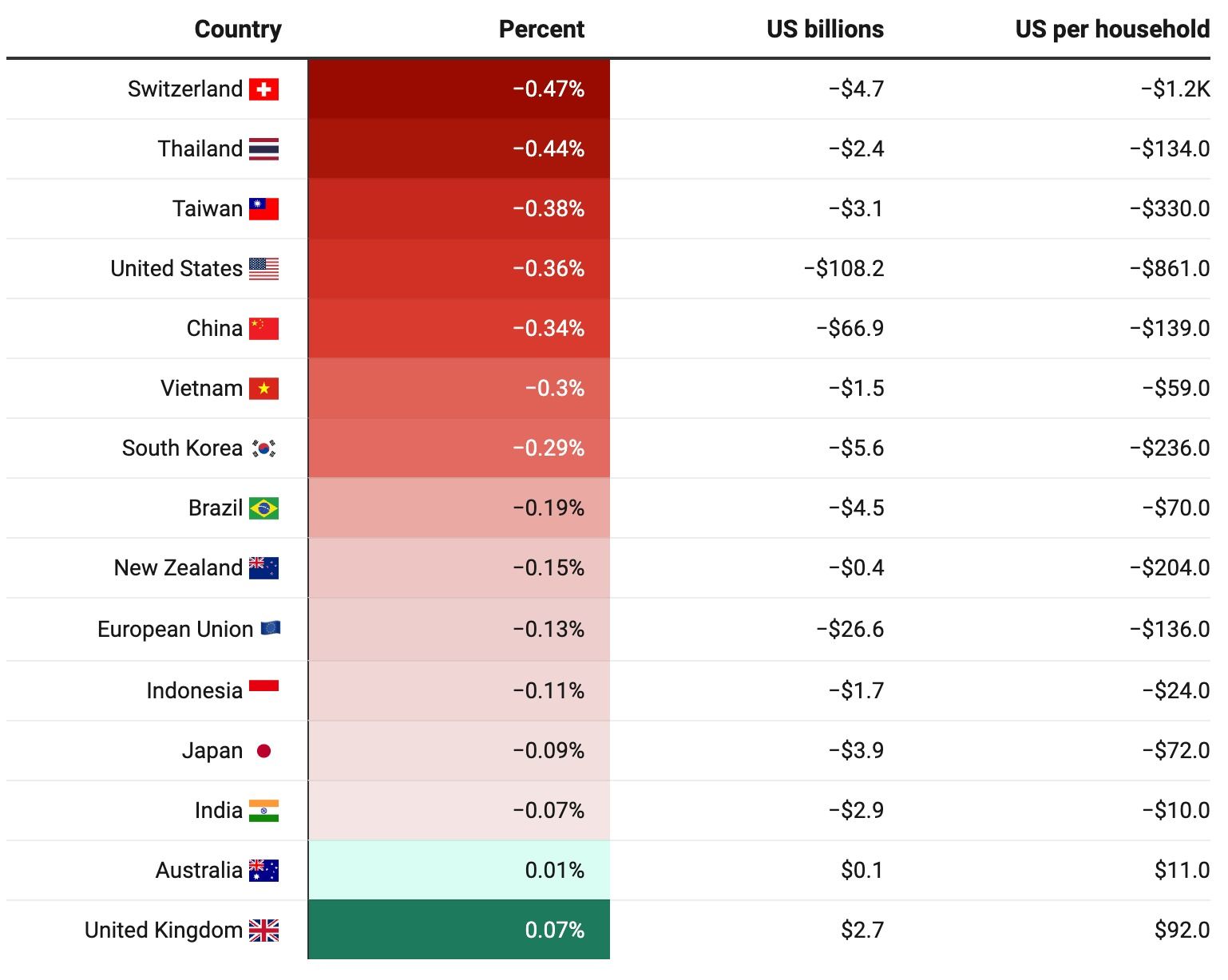
GDP impacts of the tariffs are displayed in the table below. The impacts of the additional tariffs are evaluated relative to trade measures in place before Trump’s second term. Retaliatory tariffs are not considered in the analysis.


GDP changes due to additional US tariffs

Table Showing Economic Impact on Countries — Midcoast Financial Planning Group in Tuncurry, NSW

Source: Niven Winchester

An economic own goal

The tariffs reduce US annual GDP by 0.36%. This equates to US$108.2 billion or $861 per household per year (all amounts in this article are in US dollars).

The change in US GDP is an aggregate of impacts involving several factors.

The tariffs will compel foreign producers to lower their prices. But these price decreases only partially offset the cost of the tariffs, so US consumers pay higher prices.


Businesses also pay more for parts and materials. Ultimately, these higher prices hurt the US economy.

The tariffs decrease US merchandise imports by $486.7 billion. But as they drive up the cost of US supply chains and shift more workers and resources into industries that compete with imports, away from other parts of the economy, they also decrease US merchandise exports by $451.1 billion.


Global impacts

For most other countries, the additional tariffs reduce GDP. Switzerland’s GDP decreases by 0.47%, equivalent to $1,215 per household per year. Proportional GDP decreases are also relatively large for Thailand (0.44%) and Taiwan (0.38%).


In dollar terms, GDP decreases are relatively large for China ($66.9 billion) and the European Union ($26.6 billion).

Australia and the United Kingdom gain from the tariffs ($0.1 billion and $0.07 billion respectively), primarily due to the relatively low tariffs levied on these countries.


Despite facing relatively low additional tariffs, New Zealand’s GDP decreases by 0.15% ($204 per household) as many of its agricultural exports compete with Australian commodities, which are subject to an even lower tariff.

Although the revised reciprocal tariffs are, on average, lower than those announced on April 2, they are still a substantial shock to the global trading system.


Financial markets have been buoyant since Trump paused reciprocal tariffs on April 9, partly on the hope that the tariffs would never be imposed. US tariffs of at least 10% to 15% now appear to be the new norm.


As US warehouses run down inventories and stockpiles, there could be a rocky road ahead.

Source: https://theconversation.com/new-trump-tariffs-early-modelling-shows-most-economies-lose-the-us-more-than-many-262491

Three Women in Sweaters Around a Laptop — Midcoast Financial Planning Group in Tuncurry, NSW
By Midcoast Financial Planning November 7, 2025
You’re nearly there. After a lifetime of toil – of digging, building, thinking, manufacturing, planting, helping and nurturing – it’s time for you to enjoy your Golden Years. If you’re an Australian resident, you’re entitled to an age pension and a Seniors Card. Here’s what you need to do next. Age ... Read more
Typewriter With
By Midcoast Financial Planning November 7, 2025
Hedge funds use investment strategies that are more complex than other managed funds. Many aim for positive or less volatile returns, in both rising and falling markets. A hedge fund is a complex investment and risks vary. Read the product disclosure statement and consider getting financial advice ... Read more
Man Pouring Coffee for Woman Indoors — Midcoast Financial Planning Group in Tuncurry, NSW
By Midcoast Financial Planning October 28, 2025
What’s your super strategy? Creating a strong super strategy is crucial to setting yourself up for success later in life. Starting now and making small changes to how you approach your super savings can make all the difference to ensuring you have a secure and comfortable retirement. A proactive and ...Read more
Woman Supporting an Elderly Person — Midcoast Financial Planning Group in Tuncurry, NSW
By Midcoast Financial Planning October 28, 2025
Information and resources to help you care for an older Australian. Caring for the elderly or aged means caring for someone who is either: older than 65 older than 50 for Aboriginal or Torres Strait Islander people. It may be your parent, grandparent, extended family member or loved one. You have access to ...Read more
Busy Indoor Market — Midcoast Financial Planning Group in Tuncurry, NSW
By Midcoast Financial Planning October 28, 2025
The Australian economy picked up strength in the June quarter as consumers opened their wallets, boosted by interest rate cuts earlier in the year. New figures from the Australian Bureau of Statistics showed gross domestic product (GDP) grew by 0.6% in the June quarter and 1.8% over the year — the ...Read more
Woman in Blazer — Midcoast Financial Planning Group in Tuncurry, NSW
By Midcoast Financial Planning October 21, 2025
If you’ve ever had a job in Australia, even short-term, your employer probably paid money into a super fund for you. This money is yours – even if you’ve moved, changed names, stopped using your old phone or email, or never signed up for an account. To find out how much you have you can: ... Read more
Blue Gas Flames Overlaid — Midcoast Financial Planning Group in Tuncurry, NSW
By Midcoast Financial Planning October 21, 2025
Investing isn’t just a numbers game. It’s an activity that stirs various emotions from hope and optimism to fear and anxiety. Whether the ASX is surging or stumbling, emotional responses to market movements can shape outcomes just as much as economic fundamentals. Understanding those responses is crucial ...Read more
Shipping Containers Stacked — Midcoast Financial Planning Group in Tuncurry, NSW
By Midcoast Financial Planning October 21, 2025
The global trading system that promoted free trade and underpinned global prosperity for 80 years now stands at a crossroads. Recent trade policy developments have introduced unprecedented levels of uncertainty – not least, the upheaval caused by United States President Donald Trump’s sweeping tariff ...Read more
A Young Man Cutting Vegetables — Midcoast Financial Planning Group in Tuncurry, NSW
By Midcoast Financial Planning October 14, 2025
Older Australians can access both government-funded and private aged care services, each with different costs, eligibility rules and flexibility. Understanding the differences between these options can help you or your loved ones make informed choices about the right support at home or in care. Elderly ...Read more
Woman with Shaved Head Working on Laptop — Midcoast Financial Planning Group in Tuncurry, NSW
By Midcoast Financial Planning October 14, 2025
Putting off investing could cost you more than you think Many people delay investing because they feel they don’t know enough, are afraid of making mistakes or believe they need a large sum to begin. This ‘investment procrastination’ — which can be a result of uncertainty, fear or hesitation — can ...Read more
Show More