

Can share market investors predict the future?

Midcoast Financial Planning • August 19, 2025

Volatility indexes are a barometer for where share markets may be heading


It should come as no surprise that there isn’t an accurate way to foretell what share markets will do from one day to the next.


Yet, while there is no share market crystal ball as such, there are dozens of market indexes globally that are designed to measure expected volatility for different asset classes, regions, or securities including individual shares.


These volatility indexes – some of which are tradeable on different share markets via specialist exchange traded fund (ETF) products – are forward-looking barometers that can be used as a way of gauging investors’ sentiment about the future.


Below are some of the share market volatility tracking indexes, including Australia’s own volatility index, that many traders and investors follow.


The U.S. fear index


Arguably the most widely known measure of investors’ volatility expectations is the VIX – the Chicago Board Options Exchange’s CBOE Volatility Index – which is often referred to as the U.S. markets’ “fear index”.


The VIX is a real-time tradeable index that tracks the magnitude of price changes on options contracts covering the United States’ S&P 500 Index which are due to expire within the next 30 days. Large price swings in expiring options contracts, either up or down, indicate expectations of greater volatility in the S&P 500 Index.


If the VIX is at 20, it means the market expects annualised volatility of 20% over the next 30 days.


A higher VIX reading is indicative that investors expect increased market uncertainty, while a lower reading indicates expectations of lower U.S. market volatility.


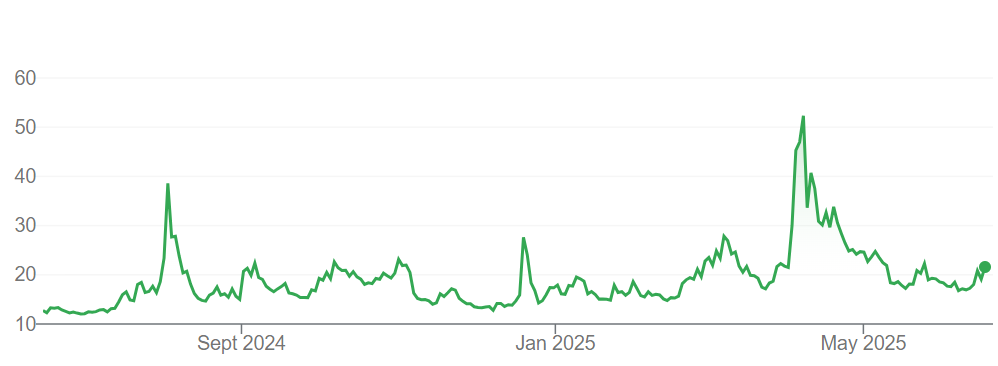
The VIX surged to an intraday high of 60.13 on 7 April on the back of a largely unanticipated downside risk—the broad U.S. tariff announcements of 2 April. This marked the highest reading for the index since the onset of the COVID pandemic in March 2020, when it spiked to 82.69, although this level was still below the all-time intraday high of 89.53 recorded during the Global Financial Crisis in October 2008.


How the VIX has moved over the last year

A Green Line Graph Showing Fluctuating Values — Midcoast Financial Planning Group in Tuncurry, NSW

Note: CBOE Volatility Index 17 June 2024 to 17 June 2025.


Source: Chicago Board Options Exchange.


Past performance information is given for illustrative purposes only and should not be relied upon as, and is not, an indication of future performance.


All investments are subject to risk, including the possible loss of the money you invest. Be aware that fluctuations in the financial markets and other factors may cause declines in the value of your account.


Australia’s volatility index


The key market sentiment indicator for the Australian share market is the S&P/ASX 200 VIX (A-VIX).


It uses a similar calculation methodology to the VIX, tracking the price volatility of options covering the S&P/ASX 200 that will expire over the next 30 days.


Relatively higher levels of the A-VIX imply a market expectation of large changes in the S&P/ASX 200, while a relatively lower A-VIX value implies a market expectation of little change. As a result, the A-VIX will often move inversely to the equity market.


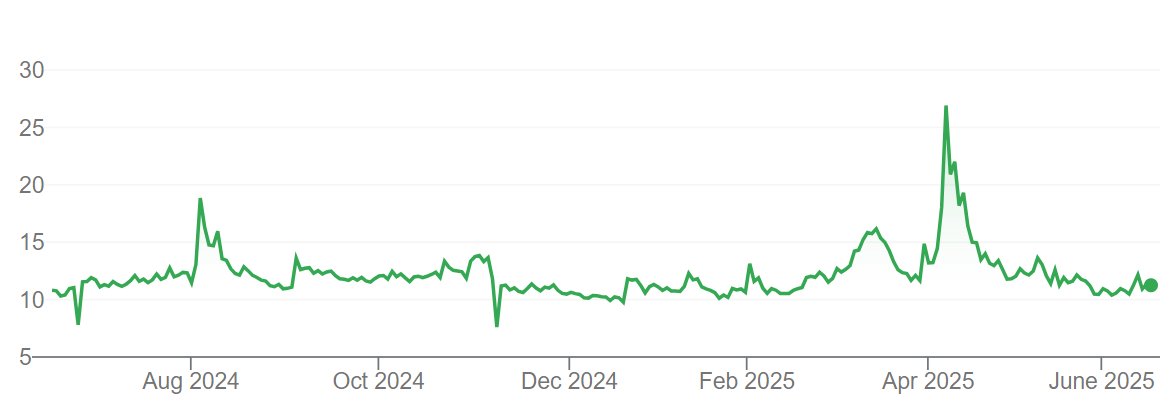
The A-VIX has followed a very similar path to the U.S. VIX over time, including in early April when the Australian share market also experienced volatility as a result of uncertainty around U.S. trade tariffs.


The A-VIX has largely mirrored the U.S. VIX

A Line Graph Showing a Stock — Midcoast Financial Planning Group in Tuncurry, NSW

Note: S&P/ASX 200 VIX 17 June 2024 to 17 June 2025.


Source: Australian Securities Exchange.


Past performance information is given for illustrative purposes only and should not be relied upon as, and is not, an indication of future performance.


All investments are subject to risk, including the possible loss of the money you invest. Be aware that fluctuations in the financial markets and other factors may cause declines in the value of your account.


The Skew Index


The CBOE Skew Index is a volatility indicator that also tracks options trading on the Chicago Board Options Exchange and is used as a pointer to so-called “Black Swan” events — difficult to predict situations that have the potential to trigger a market correction.


When there’s more buying of downside protection options, the Skew Index indicates that traders are covering off their positions against a potential market downturn.


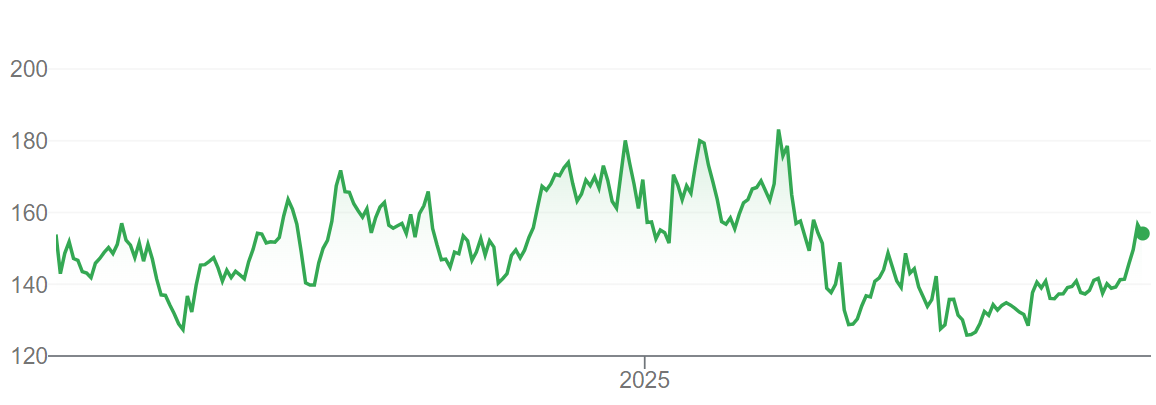
A high Skew Index suggests that traders are seeing increased risk of a major market downturn. At current levels the Skew Index is trading at a level that suggests traders expect moderately low volatility over the shorter term when compared with earlier in the year and the latter part of 2024.


The Skew reflects the positions traders are taking

A Line Graph Showing Stock Market Fluctuations — Midcoast Financial Planning Group in Tuncurry, NSW

Note: S&P 500 Skew Index 17 June 2024 to 17 June 2025.


Source: Chicago Board Options Exchange.


Past performance information is given for illustrative purposes only and should not be relied upon as, and is not, an indication of future performance.


All investments are subject to risk, including the possible loss of the money you invest. Be aware that fluctuations in the financial markets and other factors may cause declines in the value of your account.


Does tracking market volatility matter?


Indexes that measure projected volatility are useful to a point. They can’t accurately predict future market movements, but they can be used a barometer because they indicate market trading sentiment.


For long-term investors, however, short-term sentiment around volatility and near-term returns should be largely irrelevant.


Historical markets data shows that while volatility can impact returns over the short term, short-term volatility generally has had little impact on long-term returns.


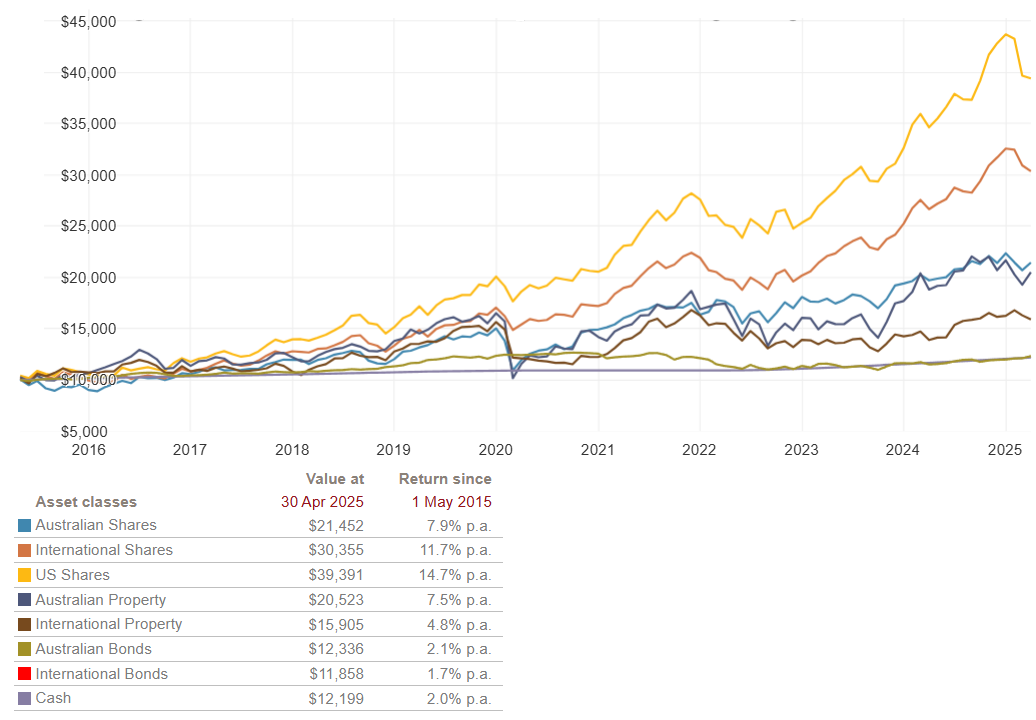
That’s clearly illustrated in the Vanguard Index Chart below, which covers the period between 1 May 2015 and 30 April 2025 and shows how a starting balance of $10,000 would have changed in value after being invested into different asset classes.


This period of time includes the 2020 COVID market crash and the more recent market volatility.


The numbers in the chart represent total investment returns. That is, they assume all investment income earned from an investment fund over time was reinvested back into units in the same fund. The returns numbers also exclude any acquisition costs, fees and taxes.

Taking a long-term view

A Line Graph Showing Investment — Midcoast Financial Planning Group in Tuncurry, NSW

Sources: Australian Bureau of Statistics, Bloomberg Finance L.P., Melbourne Institute of Applied Economic & Social Research, MSCI Inc., Standard & Poor’s, WM Reuters. Notes: 1. Per annum total returns to 30 April 2025. 2. S&P 500 Total Return Index (in AUD). 3. S&P/ASX All Ordinaries Total Return Index. 4. MSCI World ex-Australia Net Total Return Index AUD Index. 5. S&P/ASX 200 A-REIT Total Return Index. 6. Bloomberg AusBond Composite 0+ Yr Index. 7. Bloomberg AusBond Bank Bill Index. 8. Interest rate is the Reserve Bank of Australia’s Official Cash Rate. All figures are in Australian dollars. All marks are the exclusive property of their respective owners.


Past performance information is given for illustrative purposes only and should not be relied upon as, and is not, an indication of future performance.


All investments are subject to risk, including the possible loss of the money you invest. Be aware that fluctuations in the financial markets and other factors may cause declines in the value of your account.


While returns across asset classes have varied considerably, investors who have held their investment course over the long term have managed to achieve capital growth and income returns thanks to the combination of markets growth and investment compounding.


Markets volatility can be distracting and unsettling for some.


But successful investing revolves around having a well-planned and diversified strategy that’s aligned to your specific goals, and the discipline and resolve to stay the course, even during volatile investment periods.


Vanguard Investments Australia Ltd (ABN 72 072 881 086 / AFS Licence 227263) (VIA) is the product issuer and operator of Vanguard Personal Investor. Vanguard Super Pty Ltd (ABN 73 643 614 386 / AFS Licence 526270) (the Trustee) is the trustee and product issuer of Vanguard Super (ABN 27 923 449 966).
The Trustee has contracted with VIA to provide some services for Vanguard Super. Any general advice is provided by VIA. The Trustee and VIA are both wholly owned subsidiaries of The Vanguard Group, Inc (collectively, “Vanguard”).
We have not taken your or your clients’ objectives, financial situation or needs into account when preparing our website content so it may not be applicable to the particular situation you are considering. You should consider your objectives, financial situation or needs, and the disclosure documents for the product before making any investment decision. Before you make any financial decision regarding the product, you should seek professional advice from a suitably qualified adviser. A copy of the Target Market Determinations (TMD) for Vanguard’s financial products can be obtained on our website free of charge, which includes a description of who the financial product is appropriate for. You should refer to the TMD of the product before making any investment decisions. You can access our Investor Directed Portfolio Service (IDPS) Guide, Product Disclosure Statements (PDS), Prospectus and TMD at vanguard.com.au and Vanguard Super SaveSmart and TMD at vanguard.com.au/super or by calling 1300 655 101. Past performance information is given for illustrative purposes only and should not be relied upon as, and is not, an indication of future performance. This website was prepared in good faith and we accept no liability for any errors or omissions.
Important Legal Notice – Offer not to persons outside Australia
The PDS, IDPS Guide or Prospectus does not constitute an offer or invitation in any jurisdiction other than in Australia. Applications from outside Australia will not be accepted. For the avoidance of doubt, these products are not intended to be sold to US Persons as defined under Regulation S of the US federal securities laws.
© 2025 Vanguard Investments Australia Ltd. All rights reserved.

Three Women in Sweaters Around a Laptop — Midcoast Financial Planning Group in Tuncurry, NSW
By Midcoast Financial Planning November 7, 2025
You’re nearly there. After a lifetime of toil – of digging, building, thinking, manufacturing, planting, helping and nurturing – it’s time for you to enjoy your Golden Years. If you’re an Australian resident, you’re entitled to an age pension and a Seniors Card. Here’s what you need to do next. Age ... Read more
Typewriter With
By Midcoast Financial Planning November 7, 2025
Hedge funds use investment strategies that are more complex than other managed funds. Many aim for positive or less volatile returns, in both rising and falling markets. A hedge fund is a complex investment and risks vary. Read the product disclosure statement and consider getting financial advice ... Read more
Man Pouring Coffee for Woman Indoors — Midcoast Financial Planning Group in Tuncurry, NSW
By Midcoast Financial Planning October 28, 2025
What’s your super strategy? Creating a strong super strategy is crucial to setting yourself up for success later in life. Starting now and making small changes to how you approach your super savings can make all the difference to ensuring you have a secure and comfortable retirement. A proactive and ...Read more
Woman Supporting an Elderly Person — Midcoast Financial Planning Group in Tuncurry, NSW
By Midcoast Financial Planning October 28, 2025
Information and resources to help you care for an older Australian. Caring for the elderly or aged means caring for someone who is either: older than 65 older than 50 for Aboriginal or Torres Strait Islander people. It may be your parent, grandparent, extended family member or loved one. You have access to ...Read more
Busy Indoor Market — Midcoast Financial Planning Group in Tuncurry, NSW
By Midcoast Financial Planning October 28, 2025
The Australian economy picked up strength in the June quarter as consumers opened their wallets, boosted by interest rate cuts earlier in the year. New figures from the Australian Bureau of Statistics showed gross domestic product (GDP) grew by 0.6% in the June quarter and 1.8% over the year — the ...Read more
Woman in Blazer — Midcoast Financial Planning Group in Tuncurry, NSW
By Midcoast Financial Planning October 21, 2025
If you’ve ever had a job in Australia, even short-term, your employer probably paid money into a super fund for you. This money is yours – even if you’ve moved, changed names, stopped using your old phone or email, or never signed up for an account. To find out how much you have you can: ... Read more
Blue Gas Flames Overlaid — Midcoast Financial Planning Group in Tuncurry, NSW
By Midcoast Financial Planning October 21, 2025
Investing isn’t just a numbers game. It’s an activity that stirs various emotions from hope and optimism to fear and anxiety. Whether the ASX is surging or stumbling, emotional responses to market movements can shape outcomes just as much as economic fundamentals. Understanding those responses is crucial ...Read more
Shipping Containers Stacked — Midcoast Financial Planning Group in Tuncurry, NSW
By Midcoast Financial Planning October 21, 2025
The global trading system that promoted free trade and underpinned global prosperity for 80 years now stands at a crossroads. Recent trade policy developments have introduced unprecedented levels of uncertainty – not least, the upheaval caused by United States President Donald Trump’s sweeping tariff ...Read more
A Young Man Cutting Vegetables — Midcoast Financial Planning Group in Tuncurry, NSW
By Midcoast Financial Planning October 14, 2025
Older Australians can access both government-funded and private aged care services, each with different costs, eligibility rules and flexibility. Understanding the differences between these options can help you or your loved ones make informed choices about the right support at home or in care. Elderly ...Read more
Woman with Shaved Head Working on Laptop — Midcoast Financial Planning Group in Tuncurry, NSW
By Midcoast Financial Planning October 14, 2025
Putting off investing could cost you more than you think Many people delay investing because they feel they don’t know enough, are afraid of making mistakes or believe they need a large sum to begin. This ‘investment procrastination’ — which can be a result of uncertainty, fear or hesitation — can ...Read more
Show More